Do We Always Have to Walk in Their Shoes? A Mom Blogger’s Take on Content That Connects
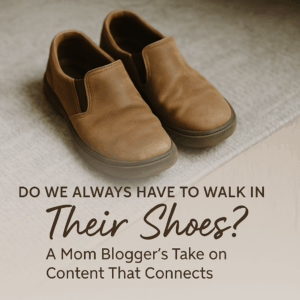 I recently stumbled on a social media post that made the rounds in marketing circles. It went something like this: “You need to walk a mile in your customer’s shoes to create content they care about. Ask about their burning pains. Talk to client-facing employees. Interview your buyers. Never guess.” I have a few comments regarding this.
So, this is a pretty solid advice for a sales team. Excellent even, if you are selling software or running a B2B marketing agency.
But as someone who runs a lifestyle blog, writes about business tips, parenting hacks, cozy home finds, and the occasional cat-related chaos—do I really need to dig deep into market research every single time I post about how to hide snacks from my kid?
Let’s talk about what this advice gets right and where it might miss the mark for mom bloggers, lifestyle creators, and multi-passionate entrepreneurs like us.
Affiliate disclosure: Some of the blog posts on Balancing Passions may contain affiliate links, which means I may earn a small commission if you make a purchase through those links.
When "Walking in Their Shoes" Does Make Sense
Let’s start here: of course it matters to understand your audience. Whether you are writing a blog post, filming a YouTube video, or making a Reel, it helps to know:
-
What keeps your readers up at night
-
What overwhelms them
-
What they wish they had time for
-
What makes them stop scrolling and then click
If you write about business tips for mom entrepreneurs, like I often do, then yes—you want to think about their pain points. They might be juggling too many roles, battling imposter syndrome, or wondering how to make a side hustle bring real income.
And you absolutely want your content to be easy to digest in the moments they do have—between naps, school pickup, or work Zoom calls. So yes, format and timing matter.
You do not have to guess about all of this. You can pay attention to blog comments. DM replies. Pinterest stats. You can talk to your friends who are also moms and business owners. Ask what they are struggling with and what kind of content would help.
That is the heart of the advice—and it does hold value.
But Here’s Where That Advice Falls Flat for Us
The original quote had a slightly rigid undertone. “You don’t do this by guessing. You must talk to client-facing employees. You must interview actual buyers.”
Here is the problem: many lifestyle bloggers and solo mompreneurs are the client-facing employee. We are also the product developer, content writer, Pinterest manager, customer support, and the person who wipes peanut butter off the camera lens.
And most of us are not building content calendars around quarterly focus groups or buyer persona interviews (yep, a bit of marketing jargon here). We are sharing what we know from lived experience. We are building connection by letting people step into our shoes—not just walking in theirs.
Sometimes the blog post that hits home the hardest was never meant to solve a specific “pain point.” It was simply a real, raw story that made someone feel seen. A post about feeling guilty for not enjoying playtime. Or what happened when you tried to build a business during maternity leave. Or a life hack that worked for you—not because it was trendy, but because it made the chaos feel slightly more manageable.
Those posts do not come from surveys. They come from lived moments.
Why Relatability Can Be More Powerful Than Research
If you are constantly chasing your audience’s pain points, you might end up sounding more like a self-help manual than a real person. There’s a fine line between being helpful and being clinical.
Your readers want to learn, yes. But they also want to feel like they are not alone. That they are not the only ones Googling “how to work from home with a teething baby” or “how to start a business while caring at home for a baby.” Speaking of how to work from home while caring for a baby, one thing that helped me during those blurry days was this wearable baby carrier I found on Amazon (and recently donated to a neighbor). It was a lifesaver when trying to type emails on my phone while bouncing a baby to sleep.
Relatability is a strategy. And for many of us, it is the secret sauce.
Your content can say, “Here is what worked for me. Here is what failed spectacularly. Try this if it fits. Ignore it if it does not.” That level of honesty and humility is exactly why people come back.
Strategy Is Still a Good Thing—But It Can Be Loose
Now, don’t get me wrong. I am a marketer at heart. I believe in having a plan, knowing your categories, optimizing for search engines, and repurposing content smartly.
But when you are writing as a mom, a solo blogger, or a creative entrepreneur—some of the best ideas hit you while folding laundry or driving to school pickup. Not in a customer interview. While I run a marketing agency for most of my week, this Balancing Passions blog is also my creative outlet, where I let the emotional, raw, and unpolished side of me come through. It is where I get to tell the truth, even if it is not trending.
And that is okay with me.
A flexible, personality-driven content strategy can still be incredibly effective. It might not look like the traditional funnel-building roadmap. It might look more like a mix of:
-
Real-life stories
-
Tutorials or product reviews
-
Affiliate-friendly tips
-
Posts that start with, “So this happened…”
The structure is looser. But the impact? Often stronger.
So... Whose Shoes Are You Really Walking In?
Here is the big question I want to leave you with:
Are you walking in their shoes? Or are you inviting them to walk in yours?
For lifestyle and mom bloggers, the answer might be: both. Some posts will speak directly to a need your readers have right now. Others will let them escape for a moment. Some will feel like therapy. Some will feel like coffee with a friend.
If it’s coming from a genuine place, it counts.
You do not need to pick one model over the other. But you do get to decide what feels right for your voice, your energy, and your season of life.
And that is something no social media “thought leader” can blueprint better than you can.